

MCP Gateway: Governing AI Agent Access to APIs in 2026

What is an MCP gateway?
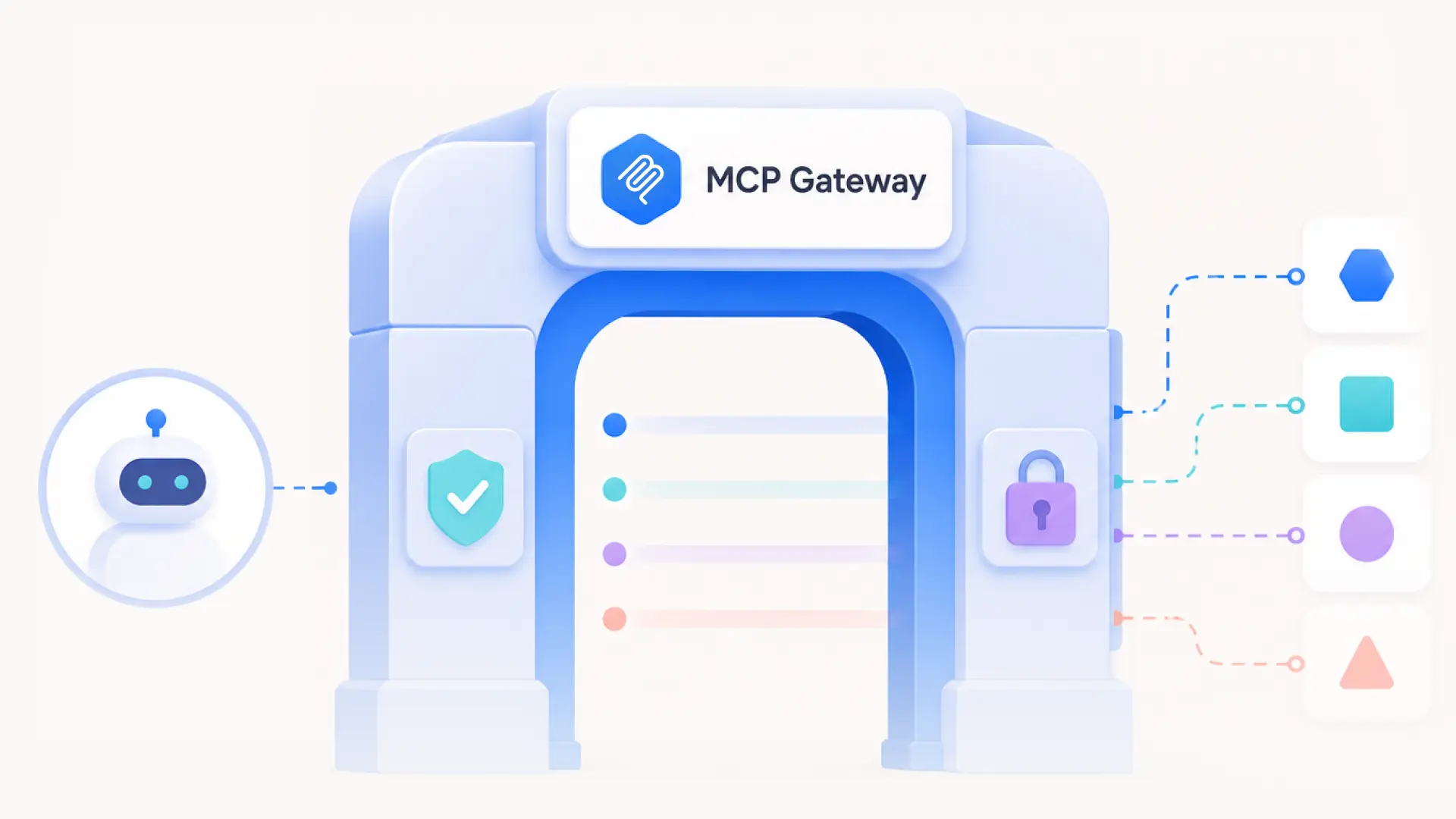
An MCP gateway is a centralized control and routing layer that sits between AI agents and MCP servers. It manages authentication, access rules, traffic limits, tool discovery, and audit records for AI agents requesting access to specific MCP servers.
An MCP gateway can perform the following functions:
- Verify the identity behind an agent request
- Determine which tools an AI agent is allowed to discover and call
- Apply limits to expensive or sensitive operations
- Keep credentials away from model prompts and configuration files
- Record tool activity for security and operational review
- Route requests to several approved MCP servers
Below, we explore how MCP gateways differ from API gateways, why agentic API access creates governance risks most enterprises have not faced before, and how to build a practical MCP gateway strategy.
How is an MCP gateway different from an API gateway and an MCP server?
An MCP server, an API gateway, and an MCP gateway solve different problems within an AI stack.
MCP server: A service that exposes tools, resources, and prompts to AI agents through the Model Context Protocol. It handles tool execution, not governance.
API gateway: A control layer that manages HTTP traffic between clients and backend services. It commonly handles authentication, routing, rate limiting, and logging. It can carry MCP’s JSON-RPC messages over Streamable HTTP, but MCP-aware inspection and tool-level policy enforcement may require additional configuration, plugins, or a dedicated MCP-aware layer.
MCP gateway: A control layer that understands the MCP protocol natively. It parses JSON-RPC payloads to identify which tool is being called, correlates the request with the calling agent's verified identity, and applies policy at the tool and agent semantic layer.
MCP sends JSON-RPC messages over HTTP. A standard API gateway can route and secure this traffic, but it does not automatically know which tool an agent is discovering or calling. This creates governance risks that require controls beyond standard API traffic management.
Why does agentic API access create a new governance problem?
Agentic API access requires additional governance because the operation and execution path may be selected at runtime rather than fully defined by the application in advance. Traditional API controls are commonly configured around a known client, endpoint, and request. An AI application can discover available tools, choose one based on model output, chain multiple calls, and act using delegated user or workload credentials.
This changes what governance must cover. Organizations must control not only which API routes a client can reach, but also which tools an agent can discover and invoke, whose identity is preserved across downstream calls, how multi-step actions are limited, and who owns each MCP server and tool.
Existing API controls still apply, but without this additional tool-level and lifecycle oversight, governance failures can appear in the following ways:
- Excessive permissions. An MCP server may expose tools with different risk levels or use broadly scoped backend credentials. Without tool-level authorization, an AI application may perform actions beyond the requirements of its task. OWASP classifies permission growth and overly broad access as MCP02: Privilege Escalation via Scope Creep.
- Unmanaged tools and servers. Teams can deploy MCP servers without registering them in a central inventory. This makes it difficult to determine which tools are available, which systems they access, and whether they follow organizational security policies. OWASP identifies these deployments as shadow MCP servers.
- Distributed access revocation. MCP does not define a central mechanism for revoking access across independent servers. Revocation depends on the identity provider, authorization server, MCP server, and credential-management process used by each deployment.
- Incomplete request attribution. A tool call may trigger requests to several internal APIs or databases. If identity and trace information are not preserved across these systems, backend logs may not identify the user, client, or tool responsible for an action.
- Missing ownership and lifecycle information. An MCP server without a documented owner, review date, or list of backend dependencies is difficult to govern. Organizations need to track who operates each server, which tools it exposes, and when it should be reviewed or retired.
- Tool poisoning. A malicious or compromised server can modify tool descriptions or schemas to influence how a model selects and uses a tool. OWASP classifies this risk as MCP03: Tool Poisoning.
- Prompt injection through tool responses. Tool outputs may contain adversarial instructions that influence later model decisions or tool calls. Responses from external tools should therefore be treated as untrusted input.
What core controls does every MCP gateway strategy need?
A production MCP gateway strategy should address five areas: identity, access control, traffic management, observability, and lifecycle management. The gateway provides a common enforcement point for these controls, while MCP servers, identity providers, API gateways, and backend services continue to enforce controls within their own boundaries.
Identity and authentication
Requests to protected MCP servers should be attributable to both the user and the client or workload making the request. For HTTP-based connections, the current MCP authorization specification uses OAuth 2.1 and Protected Resource Metadata.
An MCP gateway can validate access tokens, extract the relevant user and client identities, and reject requests with invalid or insufficient credentials before routing them to an MCP server. It can also pass verified identity information to downstream services in a controlled format.
The protected MCP server must still validate tokens intended for it unless the gateway itself acts as the MCP resource server. Local stdio connections use different credential mechanisms and do not pass through an HTTP gateway.
Per-tool access control
A single MCP server may expose tools with different risk levels. A search tool, for example, requires different permissions from a tool that deletes records or changes infrastructure.
Because an MCP gateway can inspect JSON-RPC messages, it can identify tools/list and tools/call requests. It can filter discovery results so clients see only authorized tools and enforce the same policy when a tool is called.
The gateway can also require user confirmation, step-up authorization, transaction limits, or additional approval before forwarding high-impact operations. Filtering discovery alone is insufficient; authorization must be enforced on every tool call.
Rate limiting and quotas
MCP traffic may need limits based on the user, client, tenant, server, tool, or operation. A general HTTP request limit does not always distinguish between low-cost queries and expensive or high-volume tool operations.
An MCP-aware gateway can read the tool name from a tools/call request and apply the appropriate usage policy. It can maintain separate counters for each tool and client, restrict concurrent calls, limit response sizes, enforce spending thresholds, and stop repeated failures through circuit breakers.
These controls manage traffic volume and resource consumption. Authorization and approval controls are still required for sensitive operations.
Observability and audit
An MCP gateway receives requests before they reach MCP servers, making it a central point for recording tool activity across multiple clients and servers.
For each tool call, the gateway can record:
- user and client identity, when available
- MCP server, method, and tool name
- policy decision and reason
- timestamp and session or trace identifier
- execution outcome
- approval events for sensitive operations
The gateway should redact credentials, personal data, and confidential fields before sending records to the logging system. Audit records should be stored in a centralized, access-controlled, tamper-evident system that MCP servers cannot modify. OWASP MCP08 recommends structured logging and end-to-end trace correlation.
Lifecycle and revocation
Organizations need an inventory of approved MCP servers, clients, owners, exposed tools, backend dependencies, permissions, and review dates.
An MCP gateway can maintain this registry and use it to route requests and evaluate policy. When a client or server is retired, the gateway can disable its route, remove its tool mappings, reject its credentials, and block further calls.
Credential revocation or removal of authorization grants must still occur within the relevant identity or authorization system. The gateway provides the enforcement point that prevents retired identities and components from continuing to reach protected tools
How do you discover and classify APIs before exposing them to agents?
An MCP gateway can govern whether an agent may discover and call a tool, but the safety of that action also depends on the APIs behind it. Before exposing an API through MCP, document the complete access path:
MCP client → MCP gateway → MCP server → tool → backend API operation
An MCP gateway can govern a tool call effectively only when it knows which API operations the tool invokes, what data or actions they expose, and which identities are permitted to use them.
Step 1: Build the API inventory
Combine information from API catalogs, gateway configurations, service registries, API specifications, deployment records, and runtime traffic. Include production and non-production endpoints, older API versions, and APIs operating outside approved gateways.
Automated discovery can identify gaps in documented inventories, but no single method guarantees that every API will be found. Compare multiple sources and investigate unmatched endpoints. OWASP API9:2023 recommends documenting API hosts, versions, environments, access boundaries, and retirement plans.
Step 2: Map MCP tools to API operations
For each tool, document the MCP server that exposes it, the backend API operations it calls, the credentials used for those calls, and the data or actions it makes available. Include downstream services when one tool call triggers several API requests.
Do not rely on the tool name or description as evidence of its behavior. MCP defines tool annotations as hints rather than verified security properties. The implementation and backend permissions must be reviewed separately. See the MCP tools specification.
The MCP gateway can store this tool-to-API mapping in its registry and use it when evaluating requests.
Step 3: Classify APIs and assign ownership
Record an accountable owner for each API, MCP server, and tool. The classification should include the API version, environment, lifecycle state, exposure level, data sensitivity, authentication method, required scopes, and review date.
Ownership identifies who can approve access, respond to incidents, review changes, and retire the integration. The gateway can use this metadata to route approval requests and reject tools or servers that do not meet registration requirements.
Step 4: Assess the complete access path
Assess the operation performed by the tool rather than its name alone. Determine whether it reads or modifies data, handles personal or confidential information, sends communications, moves money, changes infrastructure, or performs bulk actions.
Evaluate how the underlying APIs behave under machine-driven use. Check whether writes are idempotent, errors are machine-readable, retries are safe and bounded, and fan-out can be handled within cost, quota, and concurrency limits.
Review the backend credentials, existing authorization rules, rate limits, audit coverage, and possible effect of an incorrect call. The result determines whether the tool can run automatically or requires tighter limits, user confirmation, or additional approval.
Step 5: Convert the assessment into a gateway policy
For every approved tool, define:
- Who can discover and call it
- Which environments, tenants, and conditions apply
- Which usage limits and scopes are required
- Whether confirmation or additional approval is needed
The MCP gateway can apply this policy when filtering tools/list responses and evaluating tools/call requests. MCP servers and backend APIs must continue to enforce authorization within their own boundaries.
Review the inventory and policy whenever an API, tool definition, credential, owner, or backend dependency changes.
How does APIwiz help make API estates MCP-ready?
An MCP gateway routes requests to MCP servers, but access is also governed by the APIs behind those servers. Organizations must know which APIs exist, who owns them, what policies apply, and how they are used. APIwiz addresses these API-level governance requirements, providing the foundation for controlled MCP adoption. It complements the MCP gateway by governing the backend APIs that MCP tools invoke.
API discovery and inventory. APIwiz uses automated API discovery across cloud and on-premises environments to identify managed, unmanaged, and shadow APIs. This inventory helps teams determine which APIs are suitable for exposure through MCP tools.
Ownership and dependency information. The APIwiz Service Registry records API versions, owners, and dependencies. MCP implementation teams can use this information to identify the team responsible for approving, maintaining, and retiring each underlying API.
Design and security governance. APIwiz applies automated linting and custom governance rules during API design. Its security capabilities include policy enforcement, compliance checks, threat monitoring, and OWASP Top 10 controls. These checks help teams assess an API before making it available through an MCP server.
Runtime observability. The APIwiz Observe module provides eBPF-powered logging, tracing, and API performance metrics. When these records are correlated with MCP gateway logs, teams can trace a tool invocation from the MCP client to the underlying API operation.
Federated gateway control. APIwiz provides a single control plane for managing APIs across multiple API gateways. This helps organizations apply consistent API policies when MCP tools connect to services distributed across different gateway environments.
The Commercial Bank of Qatar case study illustrates this broader governance role. APIwiz helped establish a centralized API inventory and governance framework across more than 15 domain teams.
Although this was not an MCP deployment, it demonstrates the inventory, ownership, and governance foundation required before APIs are exposed to agents.
Key takeaways
An MCP gateway and an API gateway perform different roles. The MCP gateway routes MCP requests and applies controls to tool discovery and invocation. The API gateway manages HTTP traffic to backend APIs and services.
Effective governance requires controls at both layers. Before exposing tools, identify the APIs behind them, assign ownership, define access policies and usage limits, and establish monitoring and lifecycle processes.
APIwiz supports this work through API discovery, classification, ownership, security governance, and observability. Book a demo to see how APIwiz helps platform teams prepare their API estates for MCP access.
FAQs about MCP gateways
What is an MCP gateway?
An MCP gateway is a control layer between MCP clients and servers. It routes MCP requests and can enforce authentication, tool-level access policies, usage limits, and audit requirements.
Is an MCP gateway the same as an API gateway?
No. An API gateway manages HTTP traffic to backend APIs and services. An MCP gateway applies controls to MCP tool discovery and invocation. They can work together when MCP tools call APIs behind an API gateway.
Why do AI agents need API governance?
AI applications can discover tools, invoke them in sequence, and use delegated credentials. API governance limits which backend operations those tools can reach, records their use, and provides a process for changing or revoking access.
How do you control which APIs an agent can call?
Map each MCP tool to its backend API operations. The MCP gateway can filter tool discovery and enforce policy on every tool call. The API gateway, identity provider, MCP server, and backend service should continue to enforce scoped credentials, authorization, and usage limits.
Does an MCP gateway replace authorization in MCP servers and backend APIs?
No. A gateway provides a common enforcement point, but each protected MCP server and backend API should still validate credentials and permissions at its own trust boundary.
Can you use an existing API gateway for MCP traffic?
Yes. An API gateway can proxy MCP traffic that uses Streamable HTTP and apply controls such as authentication and rate limiting. Tool-level controls require the gateway to inspect MCP requests through native support, a plugin, or a separate MCP-aware layer.
Effortless API Management at scale.
Support existing investments & retain context across runtimes.
.webp)
Effortless API Management at scale.
Support existing investments & retain context across runtimes.